
Organ Works


München-Schwabing, St. Ursula
Restauration of the Steinmeyer organ from 1952 | III/62 (1 Ext., +2 TM, +Celesta) | 2027
The Munich parish church of St. Ursula was built in 1897 in a prominent urban location in the Schwabing district. Designed by August Thiersch, the basilica impresses with its convincing adaptation of historicist architecture in the style of the Northern Italian Renaissance, which is continued in the dignified interior design and has remained virtually unchanged to this day.
For the new church, Franz Borgias Maerz built a two-manual organ with 32 stops in 1897 as op. 349, which was rebuilt and expanded to 37 stops by the Behler & Waldenmaier workshop in 1926. War-related water damage to the organ led to its reconstruction in 1952 by Georg Friedrich Steinmeyer (op. 1827, III/58), using the windchests and pipework of the previous instrument. The Maerz pipes that were retained were completely revoiced.
The organ is located in the rear gallery, which opens onto the nave with three large arcades. The wide, barred case is interrupted in the middle by a simple arrangement of pipes. On either side – barely visible from the nave – are two narrow pedal sections. Due to the integration of parts of the romantic Maerz organ, the instrument now has two different wind chest systems: electro-pneumatic cone chests (Pedal, Hauptwerk, Nebenwerk, Swell small lower chest) and electro-pneumatic pocket chests (two wind chests in the swell and individual additional chests for the other divisions). Four large double-fold bellows supply the instrument with the required wind pressure between 90 and 100 mmWS. The organ has not been altered since its construction and is an important example of high-quality, solid post-war organ building – something that was by no means a given at the time.
A lack of maintenance led to technical problems over the years. Although attitudes toward organ building and organ music had changed in the meantime and a new organ with a completely different stylistic concept was planned, the value of the Steinmeyer organ was recognized and it was decided to simply decommission it and leave it in place, while the new instrument by Winfried Albiez (III/45) was installed in the chancel in 1984.
After forty years of slumber, we will be able to renovate the listed Steinmeyer organ in 2027 and breathe new life into it. First, all parts must be thoroughly cleaned, renovated, and restored to working order. The facade pipes will be sanded down and repainted. Maintenance accessibility, which has been limited due to the cramped conditions, will be improved by widening the facade tuning passages and moving the middle section of the organ forward.
The entire electrical system must be renewed and adapted to current safety regulations. The electro-pneumatic tone relay control system will be converted in favor of more precise playing impulse transmission, so that instead of the pneumatic transmission, new electromagnets will now directly open the cone relays of the windchests. While all tone and register membranes need to be replaced, most of the pockets only need to be refurbished. The blower will be replaced with a new motor and the wind system stabilized. To enhance the swell effect, the swell box will be fitted with a layer of lead and multiplex wood plates as well as a new electric shutter control system.
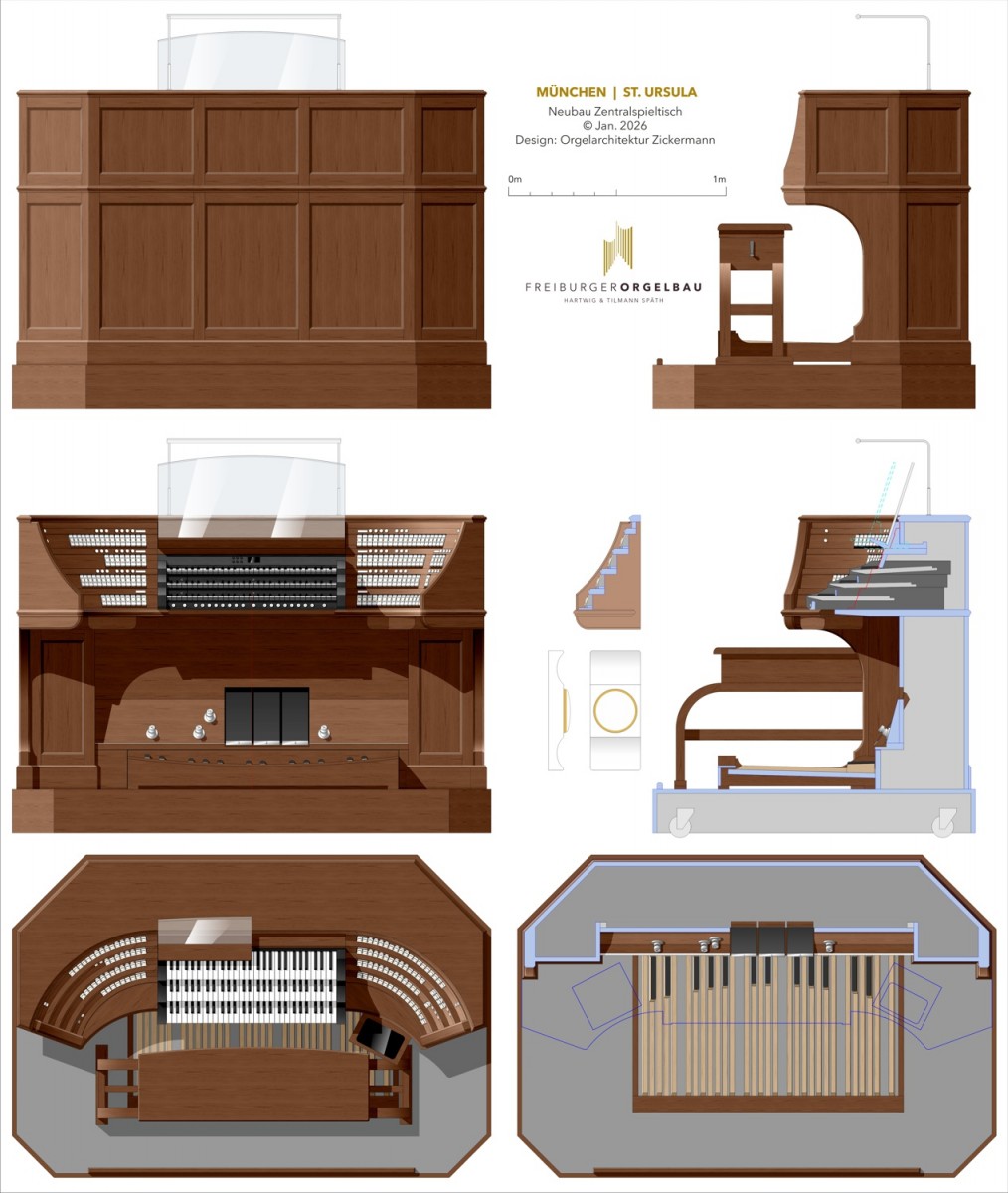
The console will also be extensively revised and equipped with new electrical and lighting systems. The operating options will be expanded with a modern setter system with touch display, additional functions (free couplers, etc.), and a MIDI interface. The choir organ will also be controllable from the old console via an operating monitor. The stop switches will be equipped with solenoids for setter use.
In terms of sound, the organ will be expanded to include a floating chamade division, a solo flute, and a celesta glockenspiel. Some previously unused stop tabs in the console will be used for the additions. The four new pipe stops will be installed on a wind chest with individual tone control. Intensive revoicing will focus primarily on balancing the stops with each other so that the Romantic and Neo-Baroque stops are united in sound in the spirit of the so-called organ movement.
A new mobile central console will be installed in the crossing area of the church, close to the liturgical action, enabling the main organ and choir organ to be played together, combining them.
Read more about the planned renovation of the Albiez choir organ here.
The church community provides information about the project on its own website: https://schwabinger-dom-orgel.de/


Disposition
I. Hauptwerk C-g3
- Prinzipal 16' M/B&W/St
- Oktave 8' M/St
- Gemshorn 8' M/St
- Grobgedeckt 8' M/St
- Quintade 8' St
- Oktave 4' M
- Rohrflöte 4' B&W?
- Quinte 2 2/3' M/St
- Oktave 2' M
- Cornett 5f. 8' M/?
- Mixtur 4-6f. 1 1/3' St
- Tuba 8' M
- Trompete 4' G
II. Nebenwerk C-g3
- Quintade 16' St
- Holzflöte 8' M/St
- Viol 8' M/St
- Metallgedeckt 8' St
- Geigend Prinzipal 4' M/St
- Pommer 4' St
- Nachthorn 2' St
- Gemshörnlein 2' St
- Spitzquinte 1 1/3' St
- Sifflöte 1' St
- Scharff 4f. 1' St
- Terzcymbel 3f. 1/4' St
- Krummhorn 8' G
Tremulant
III. Schwellwerk C-g3
- Gedeckt 16' M
- Prinzipal 8' M/St
- Nachthorn 8' St
- Salicional 8' M/St
- Schwebung 8' St
- Lieblich Gedeckt 8' M/?
- Weitprinzipal 4' ?/?
- Traversflöte 4' M
- Quintade 4' St
- Nasard 2 2/3' ?/?
- Flachflöte 2' St
- Terzflöte 1 3/5' ?/?
- Plein jeu 4f. 2' St/?
- Oktavcymbel 2f. 1' St
- Bombarde 16' G
- Feldtrompete 8' G
- Oboe 8' G
- Rohrschalmei 4' G
Tremulant
Solo (floating, 2027) C-g3
- Soloflöte 8' Sp
- Tuba 16' Sp
- Tuba 8' Sp
- Tuba 4' Sp
Celesta (56 Töne) Sch
Pedal C-f1
- Prinzipalbaß 16' M
- Violon 16' M
- Subbaß 16' M
Zartbaß 16' (Transmission III.) - Großquinte 10 2/3' M
- Oktavbaß 8' M/St
- Streichbaß 8' M
Nachthorn 8' (Transmission III.) - Choralbaß 4' M/St
- Flöte 4' St
- Rohrpfeife 2' St
- Hintersatz 4f. 2 2/3' St/?
- Kontraposaune 32' G (Extension Posaune 16')
- Posaune 16' M
- Baßtrompete 8' G
- Klarine 4' G
6 Normalkoppeln, Crescendowalze
Setzeranlage mit Touch-Display
MIDI-Schnittstelle
elektropneumatische Trakturen
M: Maerz 1897
B&W: Behler & Waldenmaier 1926
St: Steinmeyer 1952
G: Giesecke 1952
?: Pfeifen untersch. bzw. unbek. Provenienz
Sp: Späth 2027
Sch: Schiedmayer 2027